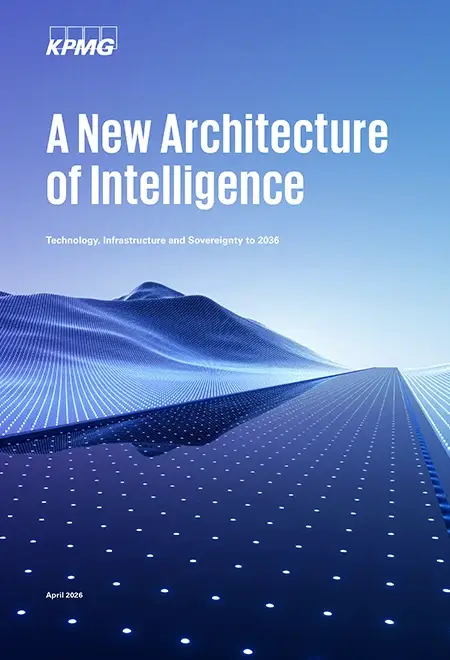
A new Architecture of Intelligence
Technology, Infrastructure and Sovereignty to 2036
Details about the publication:
ISBN
Year
Pages
Language
The rules of the game for companies are fundamentally changing. Organizations operate today in an environment where technological acceleration, geopolitical realignment, and regulatory dynamics are increasingly interacting and forcing strategic decisions under increased uncertainty. Infrastructure decisions influence sovereignty, governance shapes architecture, and technology investments shift institutional power. What was long viewed in separate contexts is increasingly being brought into a common strategic context.
These developments fundamentally shift the requirements for entrepreneurial decision-making. Strategic foresight becomes one of the key management competencies. What is crucial is not only the early recognition and identification of developments, but the ability to assess risks thoroughly, to specifically manage uncertainties, and to position companies for long-term future resilience.
The new English-language KPMG study „A new Architecture of Intelligence – Technology, Infrastructure and Sovereignty to 2036“ is based on a structured dialogue with executives from globally operating companies. The focus was on key technological developments and their impact on infrastructure, governance and sovereignty. More than 3,600 expert assessments of future developments and around 2,800 arguments and contributions to discussion were collected in a systematic, multi-stage Delphi survey process. The companies involved represent millions of employees, have significant economic influence and combine cross-industry perspectives. The exchange takes into account the increasing technological convergence and enables understanding and strategic positioning of developments in their interactions.
The technology assessments analyzed in this study provide a structured framework for systematically organizing and reflecting on key technological, institutional, and economic developments. They cover topics such as infrastructure, governance, automation, sovereignty, ecosystem architecture, data orchestration, and next-generation intelligent systems, and make visible the areas where consolidated perspectives are emerging or where uncertainties remain.
Classifying them into strategic overviews of key turning points along a time horizon provides additional guidance for possible development paths.
The future cannot be predicted, but it can be explored in a structured manner. The ability to categorize different developments, consciously consider uncertainties, and derive actionable decisions is crucial. Organizations that embed strategic foresight as part of their control logic strengthen their adaptability, systematically anticipate risks in volatile environments, and specifically seize valuable opportunities.
Download: https://hubs.ly/Q04gdhT80